
 The British Minister for English Education, Michael Gove, has called for British values to actively promoted in English schools.
Gove says that promoting British values in English schools will stop the illegal indoctrination of children in schools run by Islamists and David Cameron thinks it’s a jolly good idea.
The British values that the British Minister for English Education says English children must be indoctrinated with are:
- How citizens can influence decision-making through the democratic process
- An appreciation that living under the rule of law protects individual citizens
- An understanding that bodies such as the police and the army can be held to account by the people, through the democratic organs of government
- An understanding that the freedom to hold other faiths and beliefs is protected in law, and an acceptance that other people having different faiths or beliefs to oneself (or having none) should not be the cause of prejudicial or discriminatory behaviour
- An understanding of the problems of identifying and combating discrimination
Now, let’s just examine these British values a little more closely from the perspective of an Englishman.
How citizens can influence decision-making through the democratic process
It wasn’t all that long ago that we had a British Prime Minister who was elected in Scotland with a cabinet stuffed full of MPs elected in Scotland spending roughly three quarters of their time making laws for England. Nobody in England could influence their decisions making because the British govern England directly from London. It’s also not all that long ago that we had Tony Blair’s former flatmate, the unelected Lord Chancellor England, Lord Charlie Falconer (a Scot, naturally) telling us that we would never be allowed to have an English Parliament. I also recall the murmurs of discontent when the big supermarkets in England went to Alistair Darling (who of course is only accountable to voters in Edinburgh) to ask for Sunday Trading laws to be abolished in England like they are in Scotland but he said no. I don’t think many people who take an interest in politics or the English question will ever forget that we only have university tuition fees and foundation hospitals in England because MPs elected in Scotland overturned the slim majority of MPs elected in England who voted against them. Nobody in England has any influence over those MPs elected in other countries or the unelected lords and bureaucrats that make laws for England. And don’t even get me started on the EU which makes 75% of our laws. Seriously, don’t.
An appreciation that living under the rule of law protects individual citizens
This is an interesting one this. “If you don’t do anything wrong, you have nothing to fear” is the rallying call of fascists and big state activists alike. The fact is, it’s virtually impossible not to break the law nowadays because there are just so many of the damn things and of course problematic people need only commit a minor offence to get them into the system and ruin their lives. The book “Taking Liberties” is getting a bit old now having been written (and turned into a film) during the despotic reign of Prince Tony but most of the oppressive laws and the abuses of our hard won rights and freedoms mentioned in the book are still in force and taking place now but they’ve become so commonplace now, nobody bats an eyelid. Remember the woman who was arrested under anti-terrorism laws for reading out the names of dead soldiers outside Downing Street? How about the man charged with terrorism offences for knowing somebody who was friends with someone suspected of terrorist offences, found innocent by a jury and then put under indefinite house arrest by the Home Secretary because the jury got the “wrong” answer? This is the law that supposedly protects us by essentially stripping us of the automatic right to liberty that we’ve had for centuries.
An understanding that bodies such as the police and the army can be held to account by the people, through the democratic organs of government
Another interesting one. How do we hold the police and army to account? The police force is now heavily politicised with the introduction of elected Police & Crime Commissioners which has put nominal control of most police forces in England into the hands of political parties. Since the Police & Crime Commissioners have been in charge have we seen an increase in accountability? No. Have we been asked what we think the police are doing wrong and what we want them to do better? No. Are people unhappy with them? Yes. There is a campaign to oust the Kent Police & Crime Commissioner, Ann Barnes, to resign after bringing the police force into disrepute in an appearance on a TV documentary, the first youth crime commissioner she appointed resigned for making racist and homophobic comments on Twitter and the second youth crime commissioner she appointed was suspended just 3 months into the job for having an affair with a married police officer. She is refusing the stand down. As for what’s left of the army – how do we exercise any control over them? And more importantly, why should we be able to?
An understanding that the freedom to hold other faiths and beliefs is protected in law, and an acceptance that other people having different faiths or beliefs to oneself (or having none) should not be the cause of prejudicial or discriminatory behaviour
This is a good one because I bet the person who went to court arguing that it was religious discrimination for British Airways to allow Sikhs to wear a bangle but forcing her to remove her cross and lost doesn’t think that her religious beliefs are protected. When Muslim street patrols are out in force in Tower Hamlets abusing and threatening women who aren’t covered from head to toe and men who are drinking while the police turn a blind eye, how is that helping to prevent prejudice and discrimination? When the British government pressed ahead with legalising gay marriage in the full and certain knowledge that the EU courts would rule that it was discrimination for the established church to refuse to marry a gay couple despite it being contrary to their beliefs and teachings, how is that helping to protect the freedom of Christians to practice their religion?
An understanding of the problems of identifying and combating discrimination
This is great. Finally, our children are going to be told about the institutional discrimination against England that prevails throughout the British establishment. They’re going to be told about the British government refusing to allow the English a say on how their country is governed whilst allowing the Scots and Welsh devolved government. They’re going to be told how the British are breaking up England – starting with London and its regional assembly, then Cornwall and now a revival of the regional local government reorganisation that they planned with regional assemblies but are now targeting at cities. They’re going to be told that it’s morally wrong and unconstitutional for MPs elected in Scotland, Wales and Northern Ireland to vote on laws that only affect England which are devolved in their own countries. They’re going to be shown the list of attendees of the British-Irish Council so they can see how England has less democratic representation on supranational bodies than the Channel Island, the Isle of Man and Cornwall. They’re going to be told about the laws that only affect England that MPs elected in England voted against but which became law anyway because MPs elected in Scotland voted for them. They’re going to be told about the Barnett Formula and the eye-watering sums of money that are given to Scotland, Wales and Northern Ireland to pay for superior public services. They’re going to be told about the life saving cancer treatments and cures for blindness that are freely available in Scotland thanks to the extra funding the Scottish NHS gets from the English taxpayer that we can’t have in England because there’s no money left to pay for them.
Except they won’t be told any of the above because of the British values they didn’t include in the list:
- The English are an inferior people
- There is no cost too great to keep the Scots and Welsh happy as long as the English are paying
- Englishness must be suppressed at all costs
- An English life is worth less than a Scottish, Welsh or Northern Irish life
- War is Peace, Freedom is Slavery, Ignorance is Strength, England is Britain
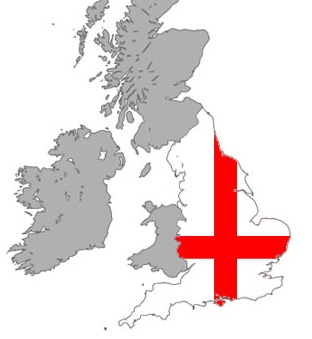
 Whilst the Queen is, of course, the Queen of the UK she is also the Queen of 16 other countries worldwide without counting the member states of the UK. This weekend’s celebrations are supposed to be for the Queen’s 60 years on the throne, not a celebration of the British state or even her reign as the Queen of the UK. Her diamond jubilee has been celebrated in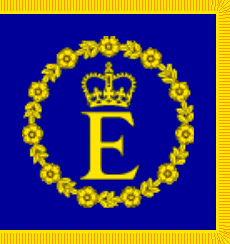
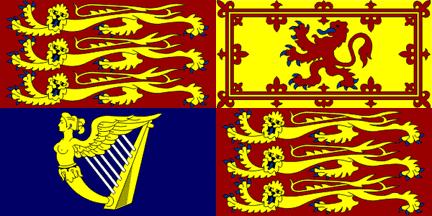

 I’ve just got back from a fortnight’s holiday – the first week was spent in Somerset and the second week in Ceredigion (or Cardiganshire as it used to be called). There was an abundance of English flags in Somerset (Burnham-on-Sea to be exact) but not to the exclusion of the British flag, just a lot more St George’s Crosses than the butchers apron. Wales was different though (at least the part of Wales we stayed in) – the only British flag I saw was, ironically, outside the Welsh Assembly building in Aberystwyth where it occupied one of the “other” flag poles to the side of the Welsh flag, the other “other” pole sporting the ring of stars logo of the EU.